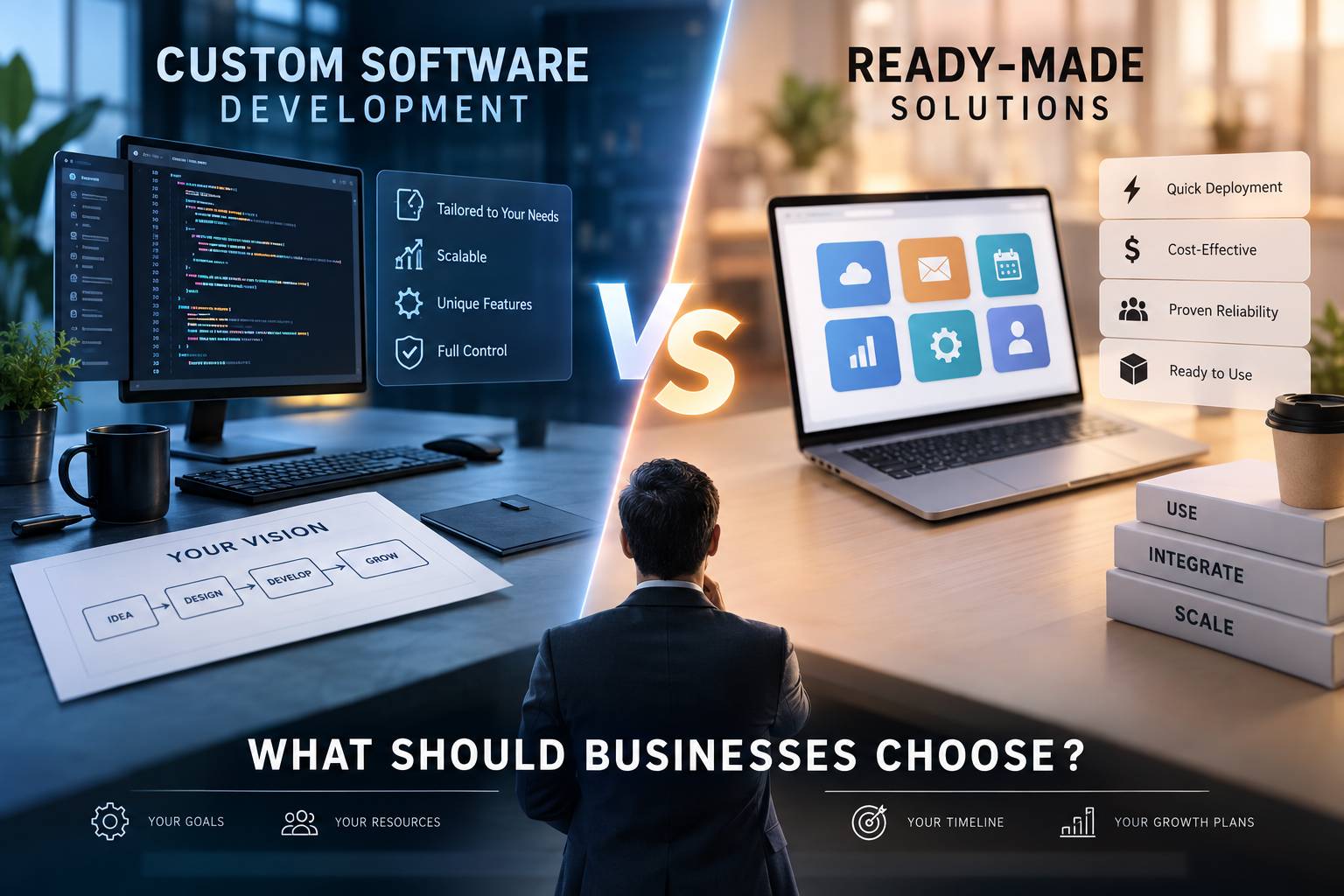
Just over half of UK organisations (51%) say they prefer pre-built agents when automating work with AI, while 48% rely on custom-made systems, according to Jitterbit's 2026 AI Automation Benchmark Report. In the United States the split runs the other way, with 55% favouring code built in-house.
The survey covers AI automation specifically, but it captures a question every UK business meets sooner or later: do you buy software that already exists, or pay someone to build it around the way you work? There is no universal answer.
The right choice depends on how unusual your processes are, how much you can spend now rather than later, and who will look after the software once it is live. This article sets out the practical differences, the costs that tend to be overlooked, and a middle route that suits many small and mid-sized firms.
What Separates Custom Software from Ready-Made Software
Ready-made software, also called off-the-shelf or packaged software, is a finished product used by many organisations. Xero, Microsoft 365 and HubSpot are familiar examples. You pay a licence or subscription, accept the features the vendor has built, and adjust your processes to fit. Custom (or bespoke) software is built for one organisation, shaped around its own workflows, data and integrations.
In practice the line is blurred. Many businesses buy in accounting and email, then commission one bespoke tool for the part of the operation that sets them apart, such as a quoting engine or a booking system. How those systems connect matters as much as which type you choose, a point explored in The Role of CRM and CMS, which looks at how customer and content platforms support growth.
Where Ready-Made Software Makes Sense
Standard needs are best met by standard tools. Payroll, accounting, email and basic project management follow rules that barely differ from one company to the next, so a mature product has usually solved them better than a small team could.
The advantages are concrete:
Speed. You can be working in days rather than months.
Predictable cost. Subscriptions are budgeted monthly or annually, with no large upfront build.
Vendor maintenance. Security patches, bug fixes and compliance updates arrive without your involvement.
Lower delivery risk. Most products offer a trial, so you can test before committing.
The drawbacks appear as the business grows. Workarounds multiply, data ends up duplicated across tools, and per-user pricing climbs with headcount. You are also tied to the vendor's roadmap: if a feature you need is not planned, you wait or go without.
A CRM shows the trade-off well. A sensible first step is to read what a platform already does, such as this German-language overview of vtiger CRM Funktionen, and compare it with a written list of your own requirements. Where the overlap is high, buying is almost always cheaper. Where the gaps fall in the areas that matter most to your business, that tells you something too.
Where Custom Development Earns Its Cost
Custom software makes sense when your process is itself the advantage: unusual pricing logic, a regulated workflow, a customer journey standard tools cannot reproduce, or integrations between systems that were never designed to talk to each other. You own the specification, set the roadmap, and are not paying per seat for features you will never use.
Cost is the sticking point, so it helps to put numbers on it. IT Jobs Watch contractor data, as reported in a 2026 UK development cost guide, puts the median UK software developer day rate at around £510 in mid-2026, although rates vary considerably by seniority and specialism. Take a hypothetical internal tool needing 60 developer days.
That is about £30,600 for development alone, before design, testing, hosting and project management. A ready-made subscription at £25 per user per month for a 15-person team costs £4,500 a year, or £22,500 over five years. On those figures, buying stays cheaper for a long time, which is why bespoke only wins when the off-the-shelf option forces costly workarounds or cannot do the job at all.
Ownership also brings obligations. If you commission software, you or your supplier must patch it, host it and defend it. The government's Cyber Security Breaches Survey 2025/26 found that 43% of UK businesses identified a breach or attack in the previous 12 months, rising to 69% among large firms.
A vendor with a dedicated security team carries part of that burden for you. With bespoke software the responsibility sits with you, along with your duties under UK GDPR wherever personal data is involved.
The Middle Route: Customising an Established Platform
Between the two extremes sits a pragmatic option: take an established platform and adapt it. Open-source CRMs and content management systems are common examples. The core is mature and maintained by a vendor or community, while custom modules, workflows and integrations are added on top.
Businesses that outgrow a CRM's standard settings can commission vtiger crm software Entwicklung to add bespoke modules, reports and integrations rather than replacing the system altogether. The approach keeps licence costs low and avoids reinventing basics such as user permissions, audit trails and reporting.
It works best when:
most of your requirements are already covered and the gaps are specific and well defined;
you want to keep the existing data and user habits rather than start again;
the platform has an active community or vendor, so upgrades keep arriving.
The trade-off is that you inherit the platform's constraints. Heavy customisation can make later version upgrades harder, so test each upgrade on a staging copy before it touches live data. If the gaps sit in the core of your workflow rather than at its edges, the platform may end up fighting you, and a purpose-built system could be the more honest answer.
Content management follows the same pattern. TYPO3, an open-source CMS popular with larger organisations across Germany and the wider European market, is designed to be extended, and firms that need hands-on expertise often turn to a typo3 agentur stuttgart for the build.
For a UK business serving German-speaking customers, multilingual content and complex editorial permissions are the usual reasons to consider a platform of this kind rather than a simple website builder.
Starting Small with a Minimum Viable Product
For a new product or internal idea, the choice does not have to be all-or-nothing. A minimum viable product (MVP) is a deliberately small first version, built to find out whether people will use the idea before the full budget is committed.
Consider a hypothetical UK recruitment agency that wants a candidate-matching tool. Rather than commissioning a full system, it could run on existing forms and spreadsheets, then build only the matching logic as a small custom component. If recruiters use it daily, the investment is justified. If they do not, the agency has lost weeks rather than a year's budget.
Front-end frameworks such as React are a frequent choice for this stage because they allow a working interface to be assembled and changed quickly. A German-language guide to React.js für die MVP-Entwicklung covers the approach in more detail. Whatever the technology, the discipline is the same: define the one problem the first version must solve, and leave everything else for later.
How to Decide
Five questions will settle most cases:
Is the process standard? If competitors do it the same way, buy.
What do the workarounds cost? Count the hours staff spend re-keying data or patching gaps, then price them.
Who will maintain it? A bespoke system needs an owner for security, hosting and fixes long after launch.
What are the data obligations? Personal data handled under UK GDPR, or sector rules from bodies such as the FCA, can favour either option depending on where the data sits.
Can you start smaller? A configured platform or MVP often tests the case for a full build at a fraction of the price.
If the answers point towards a build, judge a development partner on their discovery process, their approach to documentation and handover, and whether you will own the code. UK firms with operations or customers in Germany sometimes look to a development company based there, and IIHGlobal Deutschland is one Berlin-based example.
Buy where your needs are ordinary, build where your process is your edge, and configure where both are true. The Jitterbit figures suggest UK firms lean towards the cautious, ready-made end of the scale, but a survey average matters less than the arithmetic in your own business. Write down your requirements, put a price on the workarounds, and compare that figure with a realistic five-year cost of ownership before deciding.