A January 2025 National Audit Office report on government's approach to technology suppliers pointed to cost overruns of around £3 billion and 29 years of cumulative delay across major digital programmes. The public sector is an extreme case.
The pattern will still be familiar to any UK business that has commissioned bespoke software: the project drifts, nobody can say exactly when it began to go wrong, and by the time the problem is visible the budget has gone.
Clear key performance indicators (KPIs) are the earliest warning system a project has, and they are getting harder to define well. DORA's 2025 research, which surveyed nearly 5,000 technology professionals worldwide, found that 90% now use AI at work. It also found that AI adoption improves delivery throughput but remains associated with greater instability.
Faster output is no longer proof of progress. This article explains how to define KPIs for a custom software development project that measure outcomes rather than activity, from the first discovery workshop to the post-launch review.
Start with the business outcome, then work backwards
A metric is anything you can count. A KPI is a metric tied to a decision or a business result. Page load time is a metric; the percentage of customers who complete an order without phoning your office is a KPI, because it speaks to why the software exists.
Begin by writing down, in plain sentences, what must be different once the software is live. Consider a hypothetical Manchester distributor commissioning an online ordering portal. The outcome might be "reduce the time staff spend keying in telephone orders".
That produces KPIs such as the share of orders placed through the portal, the average minutes of staff time per order, and the order error rate. Each one can be measured before and after launch.
Keep the list short. Three to five KPIs give a steering group something it can actually discuss, whereas fifteen tend to produce a dashboard nobody reads. Include a mix of leading indicators, which warn you early (for example, the proportion of agreed features accepted at each sprint review), and lagging indicators, which confirm results after launch (such as cost per order).
Agree KPIs in writing when you work with an outsourced team
KPIs matter most when the people building the software sit outside your organisation. They give both sides a shared definition of "going well" and take much of the opinion out of progress meetings.
When comparing providers of Outsourcing Softwareentwicklung (software development outsourcing), ask how each one reports against agreed measures, how often, and in what format.
Write the chosen KPIs into the statement of work, along with how each is calculated and who supplies the data. Under a fixed-price contract, tie acceptance criteria and milestone payments to measurable results.
Under time and materials, KPIs carry more weight still, because they are your main check that spend is producing value. Vague wording such as "high quality" or "good performance" is a reliable source of disputes. "Fewer than two critical defects reported in the first 30 days after release" is not.
Four categories of KPI worth tracking
Delivery
These show how smoothly the team ships. The four DORA measures remain the most widely recognised set:
Deployment frequency: how often changes reach production.
Lead time for changes: how long a change takes from commit to release.
Change failure rate: the percentage of releases that cause a problem needing a fix.
Time to restore service: how quickly the team recovers from an incident.
Read them together. A team that deploys daily with a rising failure rate is not performing well, which is exactly the trap the 2025 DORA findings on AI-assisted development describe.
Quality
Look at defects found after release compared with defects caught in testing, the number of critical incidents per month, and security issues found in testing or review. Automated test coverage is a useful supporting figure, but it should not be a target in its own right, because it is easy to inflate without making the software any safer.
Product and user outcomes
UK public sector teams already work to a clear template. The GOV.UK Service Manual requires services to report four KPIs: cost per transaction, user satisfaction, completion rate and digital take-up. Completion rate is the percentage of users who finish a task they start, and digital take-up is the percentage choosing the online route over phone or paper. Private-sector projects can borrow all four with little adaptation, as they apply equally to a booking system or a customer portal.
Business results
Tie the project back to money and time: return on investment, payback period in months, hours saved per week, or revenue influenced by the new system. For subscription products the emphasis moves towards activation, retention, churn and monthly recurring revenue.
SaaS projects, such as those described under SaaS Entwicklung Deutschland (SaaS development in Germany), usually need those measures designed into the first release, since retrofitting analytics later is slower and more expensive.
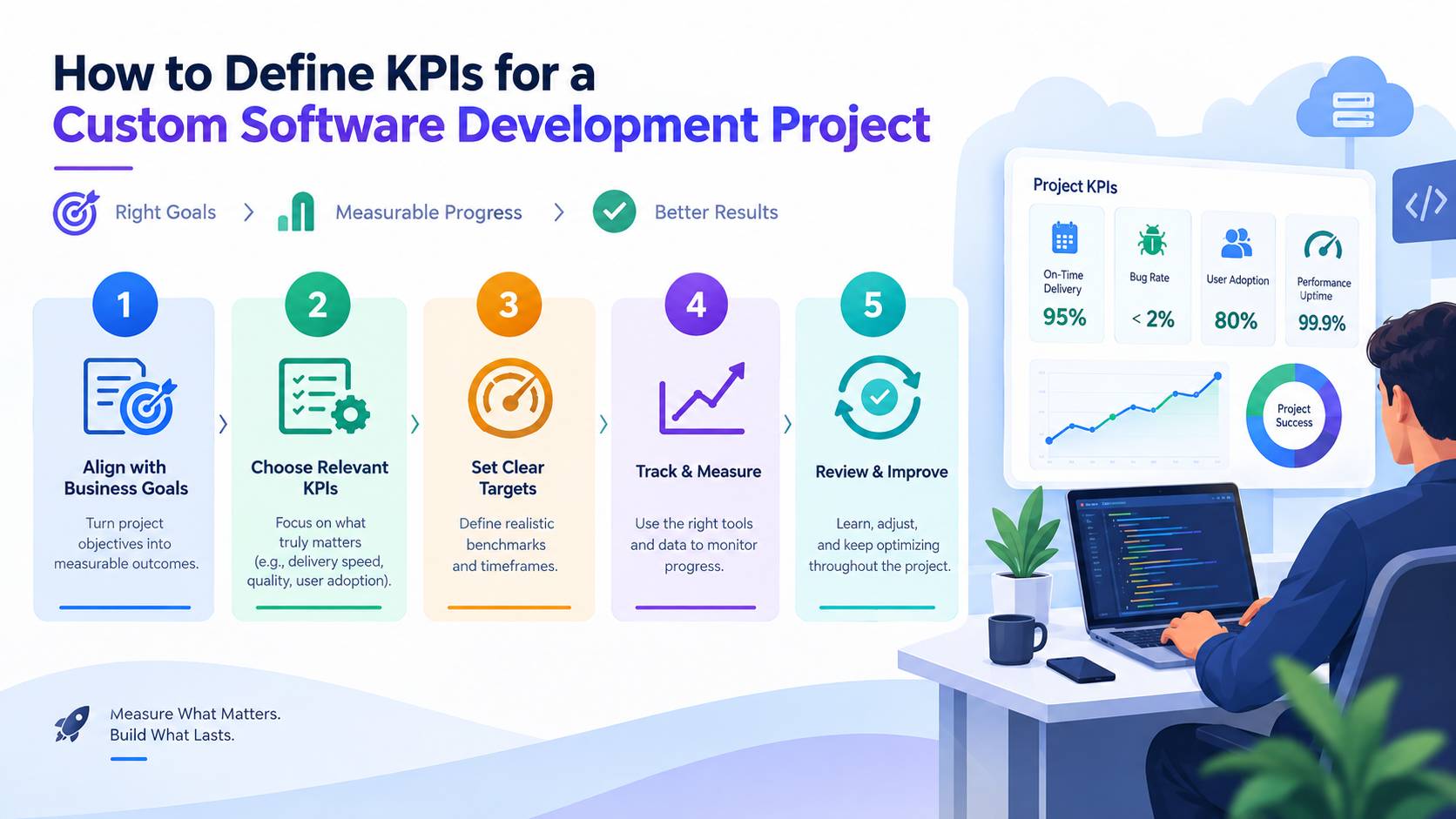
Set baselines, targets and review points
A KPI without a starting point cannot show improvement. Before development begins, record where things stand today: current order handling times, support ticket volumes, conversion rates. Without that baseline, a claim that the new system is "30% faster" is guesswork.
Record the baseline from existing data, or run a short measurement period if none exists.
Set a target and a date, for example "portal handles 60% of orders within three months of launch". Use evidence rather than ambition alone.
Name an owner for each KPI, preferably someone on the business side rather than the delivery team.
Decide how the data is collected and how often it is reported. Any analytics tooling must comply with UK GDPR and PECR, so involve whoever handles data protection in your organisation early.
Schedule reviews at fixed points: every sprint for delivery measures, monthly for quality, and at 30, 90 and 180 days after launch for business results.
Agree the reporting rhythm with your delivery partner at the outset. A software company such as IIHGlobal Deutschland can usually fit KPI reporting into its existing sprint reviews, but only if the measures are defined before work starts and not added once problems appear.
Mistakes that undermine project KPIs
Measuring activity instead of outcomes is the most common. Lines of code written, hours logged and story points completed describe effort, not value. Story points in particular lose meaning the moment they become a target, as teams adjust their estimates to look productive.
Other problems appear regularly. Targets set without a baseline cannot be defended. KPIs with no owner are reviewed once and forgotten. Dashboards reporting only good news hide the issues that most need attention. Finally, KPIs fixed at kick-off may no longer fit after a change in scope. Revisit them whenever the project's goals change, and record the reason when you do.
Measure what the software is for
The strongest KPI sets are small, agreed in writing before work begins, anchored to a baseline and reviewed on a fixed schedule. Start from the business result you want, choose a handful of measures across delivery, quality, user outcomes and commercial return, and make someone accountable for each. That gives your team, and any outside partner, a straightforward way to tell whether the project is on course while there is still time to change it.
Published by TaroNexus.